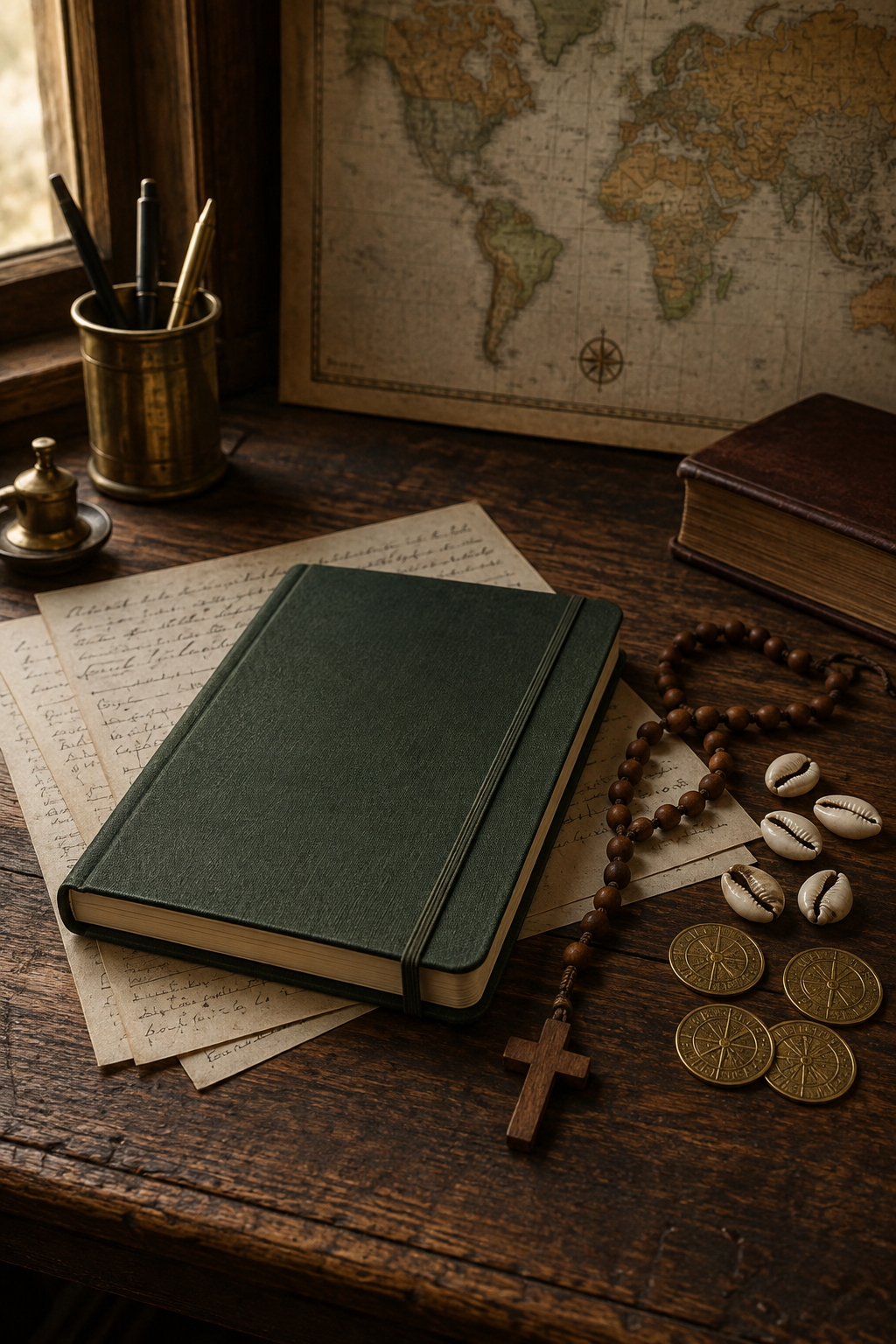
Since its creation, Catholicism has had a great impact on the world. It has given countless people a spiritual purpose on Earth, it has offered answers to questions that seemed impossible to answer, and it has given people hope that there is something better out there waiting for us in the universe and/or afterlife. On the flip side, it has also slaughtered untold numbers of indigenous populations, championed the colonization of the Americas, Africa, and Asia, and has been involved in many political, financial, and sex scandals throughout history. However, some of these terrible things have led to wonderful creations though. One of the more miraculous being the African-based syncretic religion of Santería. This paper shall examine Catholicism and Santería in order to compare and contrast their different beliefs as a way to try to better understand the impact that Catholic colonization impacted indigenous beliefs.
It is important to understand some basic statistics before we delve into the beliefs of Catholicism and Santería. According to the Annuario Pontificio, which is in essence the Vatican’s address book and a resource on practitioner statistics, in 2015 there were approximately 1.284 billion Catholics in the world. According to the Pew Research Center in 2014 about 40 percent of Catholics are located within Latin America and the Caribbean. Using this same percentage on the Vatican’s census one year later, there would be about 513.6 million Catholics in Latin America and the Caribbean. Getting a definitive number of Santería numbers is far more difficult as there have been very few, if any, national censuses that offer it as distinct choice on the census forms. There is also a fear amongst Santería practitioners “[b]ecause of the vicious persecution of its followers in the past, the stigma attached to the religion, and the allegation that it is a satanic cult that abuses animals in sacrifices, not all devotees readily admit their connections to the faith” (Murrell 2010). As Santería practitioners may also be Catholic parishioners and are fearful of potentially be outed as a Santería practitioner - they may just select “Catholic” as this answer on the official census response. These are just two of the reasons, which are the most important, getting accurate statistics regarding Santería is difficult.
Often times Santería is treated as a folk religion but it has been estimated that the number of practitioners worldwide is up to “100 million, [which is] enough to declare these diverse devotees members of a “world religion”” according to C. Lynn Carr (3). However, this number should be taken with a grain of salt as Carr later presents that there are only estimates of “22,000 to five million” Santería practitioners in the United States of America (3). Carr also states that there are “more practitioners of the Orisha traditions in the United States [of America] than in either Cuba or Nigeria (3). According to Nathaniel Samuel Murrell, there are almost half a million Santería, or some form of it, practitioners in Puerto Rico (95). He also agrees with Carr that there are more practitioners in the United States of America and Cuba (95). Murrell goes further and states that “Santería is well known as part of the Yoruba orisha tradition that has millions of followers in the Americas, most of whom are in Brazil (97). Again, these numbers vary wildly because of the deep connection between Catholicism and Santería and the stigmatization of Santería. As mentioned earlier, many Santería practitioners also stay quiet about their practices out of fear of persecution by the Catholic Church, their neighbors, and acquaintances. One such persecutory action is being labeled as Satanists or witches.
Clarification of terms used in this paper is going to be required in order to make sense of the often-ill-navigated world of Santería. First, it is important to understand that Santería is in fact a religion that was created from the blending of the Yoruba, a region within Africa that lies where present-day Nigeria, Benin and Togo are, religious traditions of Africa, Catholicism, and the indigenous populations in the Americas (González-Whippler, 1999). Santería has pulled its practice of Orisha-veneration from the Yoruba religious traditions. Orisha are deities in many Yoruba influenced religious traditions. There are many “Orisha-venerating variations [that] include Cuban Lukumi, Ifá, Brazilian Candomblé, Trinidadian Shango, and [general] Orisha worship, “Yoruba revivalism”, and other traditions brought more recently to the United States directly from Nigeria, and (to some extent) Haitian Vodou” (Carr 3). This paper will primarily focus on Santería, mainly of the Lukumi tradition, which is of Cuban origin. Santería is defined by Murrell as
“a system of spiritual communication containing beliefs and practices associated with the worship and veneration of African orishas in Cuba and in Puerto Rico’s creole African and Spanish cultures; there it blended with Catholic Christianity and native traditions in ways that allowed Santeria to keep its religious system intact. Among believers, regla de ocha is a religion of ashe (power) that enhances communication between humans and the divine for empowering the powerless in order to assuage the problems and contradictions of everyday life. It employs sacred space and symbolic signifying, as well as belief in supernatural powers, the potency of rituals, spirit mediation, divination, herbal healing, and human agency as vehicles of spiritual, psychological, and physical wholeness (96).
The terms Catholic and Christian, along with Catholicism and Christianity, will be used interchangeably throughout this paper. These terms are connected used in this paper are meant to be tied to the Roman Catholic Church; not other sects of Christianity.
This paper is broken down into smaller comparative writings that will discuss various aspects of Catholic and Santería beliefs and practices. Topics discussed include god(s), creation stories, practitioner and clerical hierarchy, rites of passage, and a recount of my trip to a “witchcraft market” in Mexico City.
God(s)
Catholicism is monotheistic. (Monotheism is the “belief in the existence of one god, or in the oneness of God” (van Baaren)). Even though Catholicism does in fact have only one God, he is often represented as taking on three separate facets according to doctrine associated with the Trinity. These three facets are the Father, the Son, and the Holy Spirit. This is the only representation of true divinity presented within Catholicism. However, Catholicism has over 10,000 saints that have been elevated above the average human. These saints had to have committed some sort of divine miracle, often acting as a vessel for God, in order to receive the honor of canonization (a lengthy and bureaucratic process performed by the Vatican); which could occur in life or death (Pope John Paul, 1983). Saints often had some sort of divine power granted directly by God - not found within themselves. Saints are also often venerated by Catholics. This blending of humanity and divine power, elevated status within the Church, and the fact that they are venerated could lead one to believe that the saints have a somewhat deity status within Catholicism - but they all still derive their divinity from God and are not worshipped as gods. There are also other figures, such as angels, that receive special attention within the Church but are, as with saints, they are not worshipped as gods. Catholicism also has the dualistic philosophy that “the world (or reality) consists of two basic, opposed, and irreducible principles that account for all that exist. . . dualism means the belief in two supreme opposed powers or gods, or sets of divine or demonic beings” - the two powers being God and Satan, Heaven and Hell, good and bad (Stefon, et al.). This results in Catholicism also paying attention to the actions of malicious spirits often referred to as demons. However, they are not worshipped in any capacity.
Santería is often believed to be polytheistic because of the multiple gods/orisha present. (Polytheism is “the belief in many gods” (Smart)). However, according to Murell, Santería is monotheistic because “it holds to the existence of one God as the central creative force in the universe and a supporting cast of spirits who are God’s extensions” (Murell 107). In Santería the one god, who is also the creator god, is named Olodumare. Olodumare presents himself as a trinity of beings known as Eleda (“[the] source of all things, including a spark of divine in humans”), Olorun (“the creator of the material world”), and Olofi (“the manifestation of Olodumare’s creation”) (Murell 107). As stated earlier, the idea of that Santería is polytheistic because of the cast supporting gods, or spirits, known as the orishas. The orishas have a somewhat hierarchical order with each orisha having their own portfolio of divine aspects, such as love, water, revenge, etc.. (Quite similar to how the Greek gods functioned within their pantheon.) The orisha are the ones that “receive prayers, sacrifices, and other worship, and they respond to devotees through oracles, spirit possession, and mediumship” - not Olodumare (Murell 107). Additionally, “[t]hey [, the orisha,] are not construed as remote distant deities, as is Olodumare, but as beings who participate in and govern the daily routines of their devotees” - they are seen as living entities that can be contacted while Olodumare is no longer in communication with humanity (Murell 107). Santería practitioners also special attention paid to the Eggun, which are the spirits of the dead. However, one should not confuse the Eggun with demons or angels as they are the spirits of humans rather than hellish or divine beings - they are our ancestors. It should also be noted that the Catholic idea of dualism is not present in Santería.
The primary syncretic belief when it comes to this category is that the orishas are the “paralleling of African divinities with Catholic saints” (Murell 101). They are neither completely African nor are they completely Catholic. Their blending was a cultural and religious survival tactic of the African slaves being forced to convert to Catholicism in the Americas (Murell 101). Santería practitioners often associate themselves through initiation rituals with one, or more, orishas and often worship the orishas directly. In Catholicism, practitioners may pick a patron saint, or more, in order to help them better, or differently, connect to God. This results in a key difference in the saints and orisha: who is actually receiving the worship and who is actually being recognized as a god. Another key difference between the Christian and Santería gods is that the Christian god is actively working with his practitioners associated with the Catholic Church but the Santería god is distant from Santería practitioners (Murell 107\). There is much overlap between orisha and saints even though they stand for something different in religious execution and meaning. Becoming dedicated to an orisha could also be compared to the different Catholic religious orders (such as Franciscans, Benedictines, etc.) as both have different sets of liturgy, rites, rules, etc. but still follow the same core religious tenets. The individuals dedicated to Elegba would have different worshipping practices than those who have dedicated themselves to Oshosi just as the Franciscans have different monastic practices than those who are Brigittine.
However, in both Catholicism and Santería, the discussion of monotheism and polytheism is up to debate given that lower divine beings are capable of being worshipped by both groups of practitioners. One could also argue that that trinity reflected in both gods could be indicative of different entities. Additionally, that there are entities that are worth worship or veneration who were previously human - it could mean that humans themselves are divine (the Elegun and the saints). This is a discussion for another paper completely but they do warrant addition here because it is a trait found in both. (It should also be noted that these statements could be deemed as blasphemous by the Catholic Church as they are very clear that the one God is the only source of divinity.)
Creation Stories
The Catholic creation story is explained in the first book of the Holy Bible. Genesis I tells us that God created the heavens and earth. He then created night and day on the first day, sky and sea on the second day, plants on the third day, the celestial bodies on the fourth day, birds and fish on the fifth day, land animals and humans on the sixth day, and rested on the seventh day. This worldly creation story is rather straightforward but does not discuss where God came from. However, we do get an indicator that he is human-like as later in Genesis we are told that “God created mankind in his own image, in the image of God he created them; male and female he created them” (Genesis 1:27). This creation story is male-centric (such as how woman is made of the first man’s ribs in Genesis 2:21) and it also leaves a lot of questions (for example, how does God know what both male and female look like if he created them in his image) unanswered about the origin of God and if there are perhaps other Gods. How did God come into being himself?
The Santería creation story is quite difficult to piece together given all of the various traditions, lineages, and cultural influences. However, one particular incarnation of the story states that the God Olodumare resided, along with the orishas he created, in a heaven-like land together before the earth was created by Olodumare. While this is a just one version of the story, there are, according to Murell, three primary legends for the creation of the world. The first is that Olodumare created “all of the intermediate beings [,orisha and the such,] and endowed them with his power to work on his behalf in the natural and spiritual worlds” (107). This is similar to the Christian creation myth but instead of God doing all of the work - God creates workers who do all the work for him. The second myth is that Olodumare’s three facets are charged with creating the world and everything within, which is in essence, himself doing the work like the Catholic god did. The third myth is that Olodumare designated the “creation of the natural world of humans and physical things to orishas, who now supervise their harmonious working through a system of rewards and punishments, life and death, and health and sickness” (Murell 107). The three myths are quite similar and all emphasize that Olodumare is the ultimate creator while having the orisha as his assistants in the process.
The creation myths in Christianity and Santería have quite a few overlaps: there was a single god, this god created the world as we know it, and that there were additional beings created by said (being divine as in the case of orishas, or not as in the case of humans). This could be due to the syncretic nature of Santería or it could have just been a coincidence. I was unable to find a creation myth that was fully accredited to Yoruba beliefs in Africa so I do not feel confident enough to make a declaration on the topic.
Practitioner and Clerical Hierarchy
The Catholic Church has a very elaborate clerical hierarchy that consists of many official, and sometimes unofficial, auxiliary bodies and organizations. Santería does not this kind of structure as it mostly relies on smaller congregations and initiatory bodies, which are often very localized. The Catholic Church and Santería both had places at the national level of society at some point in time. The Catholic Church had monarchs, such as Queen Isabella I of Castile and King Ferdinand II of Aragon, that were able to further the Catholic agenda in their home country (Spain). Santería at one point had grand congregations that consisted of national assemblies of individuals of African ethnicity primarily in the Caribbean (Murrel 2010). (There were, and are, also national assemblies of other Yoruba-based religious organizations still functioning in Africa.) However, this national level of worship for both Catholicism and Santería has disintegrated in almost all places. There are still a few Catholic monarchies left in the world (Belgium, Liechtenstein, Luxembourg, Monaco, and Spain) but they hold very little religious importance in their respective countries as the religious importance has shifted to the Pope at the Vatican. The average Catholic practitioner also often only concerns themselves within their local church rather than the Catholic Church as a whole. The same goes for Santería as “[their] institutions increasingly took on the liturgical forms of the rites of private ‘houses’ rather than the civil or ‘national’ assemblies" (Murrel 2010). This shift from national to personal/communal worship, in the scope of Catholicism and Santería, has occurred in almost all countries, sparing Cuba and Italy.
The primary difference between Catholicism and Santería when it comes to local, national, etc. is that a super-international-organization (The Vatican) exists and that is provides many different levels of hierarchy. The Catholic Church is organized into different rites (which have liturgical differences amongst themselves), which are then organized into different levels of superiority over lower bodies (such as the diocese being the body of oversight of parishes in it’s declared region). The Catholic hierarchy of clergy is a serpentine labyrinth with many different positions and rankings based on location. The highest authority is the Pope, a position that is elected by the Bishops (John Paul II, 1996). There are multiple tiers of priesthood, which are too cumbersome to detail in this paper, along with many different colleges (which are ruling bodies over different areas of the Catholic Church), monastic orders, religious orders, and various autonomous churches within Catholicism. Most members of the Catholic priesthood have to go through seminary school in which they receive instruction on the Catholic Church and Christianity. They then, if they so desire, progress through the ranks based on nominations, elections, and appointments - depending on the structure they seek to elevate themselves within.
The Santería hierarchy of clergy and practitioners is rather straightforward, to a point. A priest within Santería has to go through many different initiation rites and processes as they continue to grow in their divine understanding. There are no formal colleges/seminary schools as there are with Catholicism. The priesthood is organized into multiple ranks which are organized into two classes: babalawos and santeros. The individuals in the higher class are called babalawos, which are also known as high priests. All individuals within this class have “received the consecration of Ifá” (González-Wippler 84). (Ifá is a form of divination that involves either cowrie shells, a necklace with representative figures of the orishas, or using coconut shells.) Within this class, the highest-ranking members of high priesthood are called omokolobas. The omokolobas have undergone an initiation rite known as Olofi. They are at the pinnacle of the religion but are different than the pope and upper clergy Catholicism in that they do not make decisions for all practitioners of Santería. They still focus on their religious family and those who come to them for assistance. The next rank within the the babalawos class are those who have have undergone an initiation rite called Cuanaldo . The individuals of following rank are known as oluwos and have undergone a religious coronation known as asiento, which is when they receive the initial consecration of Ifá. The next class, the Santeros, are considered the general priesthood of Santería. The highest rank in this class is those who have undergone an initiation known as the Pinaldo. The rank below this is those who have undergone the kariorioacha initiation (González-Wippler 84). There are additional ranks beneath these two classes but they are associated with the laity or those intending to become priests and involve receiving different initiations and tools important to their religious practices. Beyond this, there are also additional titles bestowed upon the priesthood and laity based on their actions within the religion of Santería. Some examples include babalocha (which “is a santero who . . . has presided during [an] asiento ceremony”), baba (which is the “[religious] father of an orisha, [meaning an initiated santeros],) and oriate (which is the “master of ceremonies during the asiento”) (Murell 86).
Rites
The Catholic Church has seven official rites which are called sacraments. These seven sacraments fall into one of three categories: initiation, healing, and service. The sacraments of initiation are baptism, confirmation, and holy communion. The sacraments of healing are penance and anointing the sick. The sacraments of service are matrimony and holy orders (Annuario Pontificio, 2017).
The sacrament of baptism is the initial step into joining the Catholic faith. It is often a simple oath that is taken by parents on behalf of their infant. Adults can also undergo this rite if they are converting to Catholicism. This oath is performed with a priest and involves the individual being submerged, to some degree, in water. The sacrament of confirmation involves the individual being free of mortal sins either by innocence or confession, being anointed with a special oil by a priest, and making the conscious decision to continue in the Catholic faith. The sacrament of holy communion involves the consumption of a cake that is to symbolize Jesus’s body and a liquid, often wine, that symbolizes Jesus’s blood. This is the acceptance of his teachings and his sacrifices. These three sacraments must be performed in this order.
The sacrament of penance involves the confession of sins to an authorized priest, as not all priests can handle all cases of sin, and completing the priestly-prescribed course to make amends for said sin. Often times the process of making amends involves praying with a rosary, attending a specific mass, or partaking in the holy communion. The anointing of the sick rite involves an individual who is near death, ill, or old being anointed with a special oil that prepares them for the afterlife or calls upon God for the individual to have better health.
The sacrament of matrimony is the marriage of Catholics who vow to uphold the Catholic faith. The sacrament of holy orders involves entering into the priesthood and living by the vows they make in doing so. Only men are able to partake in this sacrament.
Santería also has many different rites - the number being too large to handle in the confines of this paper and level of research so only a few will be addressed. There is no formalized system as there is with Catholicism but it seems that they could be categorized as being priest rites and laity rites. One thing that stands out as a big difference between Santería and Catholic rites is that Santería rites almost always provide the individual with a physical representation of the rite being completed.
There is a series of rites known as aleyos that seems to be similar to the Catholic sacraments of confirmation. During the the rites of aleyos, the individual learns the foundations of Santería. They receive multiple necklaces which represent different orisha and the Warriors, which are physical representations of the orishas Eleggua, Oggun, and Ochosi (Gonzalez-Wippler, 16).
There is also a form of baptism within Santería in which the parents of a child promise the child to an orisha, or multiple orishas. This can be done for purely religious purposes or as a plea for something such as wealth, good health, etc. It is up to the parent to seek the proper training for the child or risk angering the orisha(s) (Carr, 2016\).
The entrance to priesthood is marked by a year long rite known as the kariorioacha in which an individual must follow strict protocols in every aspect of their life. They must abstain from most non-religious social interaction, they must not look into mirrors, they must maintain a clean state (physically washed), eat on the floor on a personal mat with personal utensils, wear complete white, only allowed certain types of haircuts, etc. The different rules depend on the initiating family and orisha being involved in the process. (Carr, 2016).
Sample Artifacts: Opele and Rosary
Santería and Catholicism both have necklace-like artifacts that are quite similar in visual representation but have very different uses. Santería has the opele while Catholicism has the rosary. Overall, there does not seem to be much more of a connection than the visual representation and that neither is typically worn around the neck as the opele is firmly rooted in non-syncretic African religious practices.
The opele is a chain used as a tool for divination by the priests of the Ifá tradition, which includes Santería, called babalawos. The opele is typically constructed of an “iron chain that connects eight oval medallions usually made of coconut rinds [,but other materials such as nuts, seashells, and turtle scutes can be used,] . . . that has a different design on either of its two sides” (Gonzalez-Wippler, 96). This design can be as simple as a polished and unpolished side, the interior or exterior of a nut, etc. or as intricate as hand carved medallions where one side has the physical representation of an orisha and the other side does not. As is the case with most devotional objects, the opele is associated with the Ifá orisha (god) named Orunla. This is quite fitting as Orunla is the orisha of divination. A situation must be presented to a babalawo in order for the opele to be consulted. This could be a marriage, an initiation, a general consult, advice on spiritual actions, etc. The babalawo begins a reading by holding the chain in the middle and throwing it down on his altar so that the four medallions on each side land parallel to each other. The babalawo then takes note of which images are present on each medallion to create an oddu (the pattern). He, a babalawo is traditionally always a man due to the origins of divination, then interprets the situation based on the verses, patakis (short stories), and prayers associated with the oddu. (There are 256, 2 options for 8 sources, different oddus that can occur with the medallions.) This is the very basics of how the opele is used in divinatory practices. It is also used in more elaborate processes such as when a Santería practitioner seeks to discover which orisha they are to be dedicated to, a more involved reading, and the use of more than 256 different oddu (it has been stated that there may be as many as 65,536 oddus with a total of 110,100,480 different patakis) (Gonzalez-Wippler, 96-98).
The rosary is a type of necklace that consists of multiple beads and a crucifix. The number of beads varies depending on the particular Catholic practitioners beliefs and/or needs of the rosary. Unlike the opele, the rosary can be used by all members of the Catholic faith. The basic use of the rosary revolves around the individual reciting a prayer component as they touch each bead and point of the crucifix while meditating on the mysteries revolving around Mary and Jesus. Some common prayers recited while using the rosary are “Hail Mary” and “The Lord’s Prayer.” This frequency of using the rosary vary wildly: some devout Catholics may perform it multiple times a day while other Catholics may perform it only once or twice in their lifetime.
Experience in Mercado de Sonora
Originally I intended to write about the influence of indigenous religions on Catholicism in Latin America. This quickly changed as I began my initial research and realized that there were not as many resources as I was expecting. The few sources I did find were in Spanish or difficult to place into my paper as they were only written from the Catholic Church’s viewpoint. I realized that I had also cast my net too wide - there are far too many vibrant cultures and indigenous religions in order to write a somewhat accurate paper. While this paper has focused on Cuban Santería of the Lukumi tradition, during my initial research I read and was told that there was also quite a few Santería practitioners in Mexico. Due to ease of travel and affordability, I had decided to take a small trip to Mexico City to explore the Mercado de Sonora. The Mercado de Sonora is often known as a witchcraft market where one could buy animals for sacrifice, religious icons, herbs, magical products, etc. These are my observations and conclusions of that trip.
I met my tour guide and translator on December 2, 2018 at my rental in Mexico City. We were travelling to the Mercado de Sonora together in order to prevent myself from getting lost as it is a difficult place to get to. This day, Sunday, was chosen as it was often the busiest and had the most stalls open. My tour guide explained to me that the section of the market we were going to was primarily frequented by tourists, locals in desperate need of help, or those who were often interested in superstitious. I was not expecting to find many direct connections to Santería after hearing these initial comments.
My initial observations confirmed that I was not going to find what I was looking for here. The first few sections consists of tall votive candles with Catholic saints represented on them (something I have come to see quite often while living in the Bronx), Catholic saint statues and pictures, rosaries, and other Catholic-oriented products. I did, however, notice that most of the saints, or humans, represented upon the candles and artwork were very pale-skinned. Perhaps as an association with the white people that brought the religion of Catholicism to Mexico. As we continued down the long maze-like corridors towards the back of the market, I started to notice that the products for sale were becoming more associated with indigenous and folk religions. First came stalls with different washes and powder that were meant to invite, or banish, things (such as love, money, evil spirits, etc.) from one’s home. Then came stalls full of dried roots, barks, and leaves of all sorts. Then, we reached the back of the market, and I was overwhelmed with what I saw.
Here there were stalls that were selling all of the different core Santería religious items I had been reading about. Additionally, I recognized items from Vodou. One of the first items that grabbed my attention were the stones that had cowrie shells for eyes, nose, and mouth. This was something that I had read about being associated with the orisha Eleggua. It was my also my understanding that these were to be created in ritual context for an individual - not sold en masse. My translator asked the stall owner what they were and the only answer she could give was that they were “to prevent bad spirits”. No name of an orisha, no mention of Santería, and in my opinion, no real details as to what the artifact was actually for.
Another stall I found only sold opeles (then chains used in divination). Some were extremely elaborate and gilded in metals. Others were simply laminated paper on what appeared to be sewing threads. When asked what they were, we were told “something to help you see the future”. Another lackluster response that really did not hint at to their role within Santería. This particular tool is also only meant to be used by a specific person, the babalawos, within Santería - not just the average practitioner. This was another religious artifact that seems rather out of place in a general Mexican market. There were also statues associated with the orishas mixed in throughout the vendors. I noticed that most of them were depicted with black skin. This created a stark contrast between the Catholic saint iconography I saw earlier - especially since I did not really see any white or black individuals, at least in the [US]American sense, present anywhere within the market.
We walked by a section full of animals where vendors offered to sacrifice and/or butcher the animal if you bought it from them. Some claimed that there animals were blessed by a “bruja” or “chaman”. While animals are sacrificed in Santería, this particular environment seemed like a general market where one could get any animal they wanted for any purpose, including for general consumption. My guide did tell me that there were some shady vendors that had access to more exotic animals. However, reading that these were often endangered animals and illegal to posses, I chose not to venture down that path.
Based on my very limited experience in this environment and my limited understanding of the intricacies of Santería, I feel that the Mercado de Sonora is more of a tourist attraction than an actual hub of Santería, or any true folk religion, practitioners. Locals do visit the area but they often do so for something generically magical rather than something of religious nature, other than perhaps folk Catholicism. I make this conclusion based on the lack of understanding on behalf of the vendors when it came to Santería artifacts, the selling of artifacts that are typically created for a single personal in a ritual or initiatory setting, and, although minimally, the lack of black presence in the market or the modification of iconography to represent the locals.
Works Cited and Bibliography
*Annuario Pontificio*. The Vatican Publishing House, 2017.
Carr, Lynn C. *A Year in White: Cultural Newcomers to Lukumi and Santeria in the United*
*States*. New Brunswick, NJ: Rutgers University Press, 2016.
Catholic Church. *Catechism of the Catholic Church*. 2nd ed. Vatican: Libreria Editrice Vaticana,
2012\.
Desmangles, Leslie G. *Faces of the Gods: Vodou and Roman Catholicism in Haiti*. Chapel Hill,
NC: University of North Carolina Press, 1992.
Fernandez Olmos, Margarite and Lizabeth Paravisini-Gebert. *Creole Religions of the Caribbean:*
*An Introduction from Vodou and Santeria to Obeah and Espiritismo.* 2nd ed. New York,
NY: NYU Press, 2011.
Gonzalez-Wippler, Migene. *Santeria: The Religion*. St. Paul, MN: Llewellyn Publications, 1989.
Johnson, Paul Christopher. *Secrets, Gossip, and Gods: The Transformation of Brazilian*
*Candomblé*. Oxford: Oxford University Press, 2002.
Laguerre, Michel S. *Voodoo and Politics in Haiti*. New York, NY: St. Martin’s Press, 1989.
Meighoo, Sean, Frederick Ivor Case, and Patrick Taylor. *Encyclopedia of Caribbean Religions*.
Champaign, IL: University of Illinois Press, 2013.
Michel, Claudine and Patrick Bellegarde-Smith. *Vodou in Haitian Life and Culture: Invisible*
*Powers*. New York, NY: Palgrave Macmillan, 2006.
Murrel, Nathaniel Samuel. *Afro-Caribbean Religions: An Introduction to Their Historical,*
*Cultural, and Sacred Traditions*. Temple University Press. 2010. https\://www\.jstor.org/stable/j.ctt1bw1hxg.9. Accessed January 7, 2019
Polk, Patrick A. “Objects of Devotion: Sacramental Imagination and the Sacred Universe of the
Botanica”. In *Botánica los Angeles: Latino Popular Religious Art in the City of Angels*. Los Angeles: UCLA Fowler Museum of Cultural History, 2004: 26-45
Pope John Paul. “Divinus Perfectionus Magister.” 1983.
Pope John Paul II. “Universi Dominici gregis.” 1996.
“Religion in Latin America.” *Pew Research Center*. http\://www\.pewforum.org/2014/11/13/
religion-in-latin-america/#. 13 Nov 2014. Accessed November 16, 2018.
*Rosary Center and Confraternity.* https\://www\.rosarycenter.org/. Accessed January 9, 2019.
Smart, Ninian. “Polytheism”. *Encyclopedia Britannica.* https\://www\.britannica.com/topic/
polytheism. Accessed November 14, 2018.
Stefon, Matt and Ugo Bianchi. “Dualism.” *Encyclopedia Britannica*.https\://www\.britannica.
com/topic/dualism-religion. Accessed November 16, 2018.
*The Bible*. New International Version, Zondervan, 2011.
*The Catholic Encyclopedia*. New Advent. http\://www\.newadvent.org/cathen/.
Van Baaren, Theodorus. “Monotheism: Theology.” *Encyclopedia Britannica*.
https\://www\.britannica.com/topic/monotheism. Accessed November 14, 2018.
Wirtz, Kristina. *Ritual, Discourse, and Community in Cuban Santeria: Speaking a Sacred World.*
Gainesville, FL: University of Florida Press, 2007.
Conversation beneath the branches
Comments
No approved comments yet. You may be the first to join the conversation.