Book review
Living in the End Times
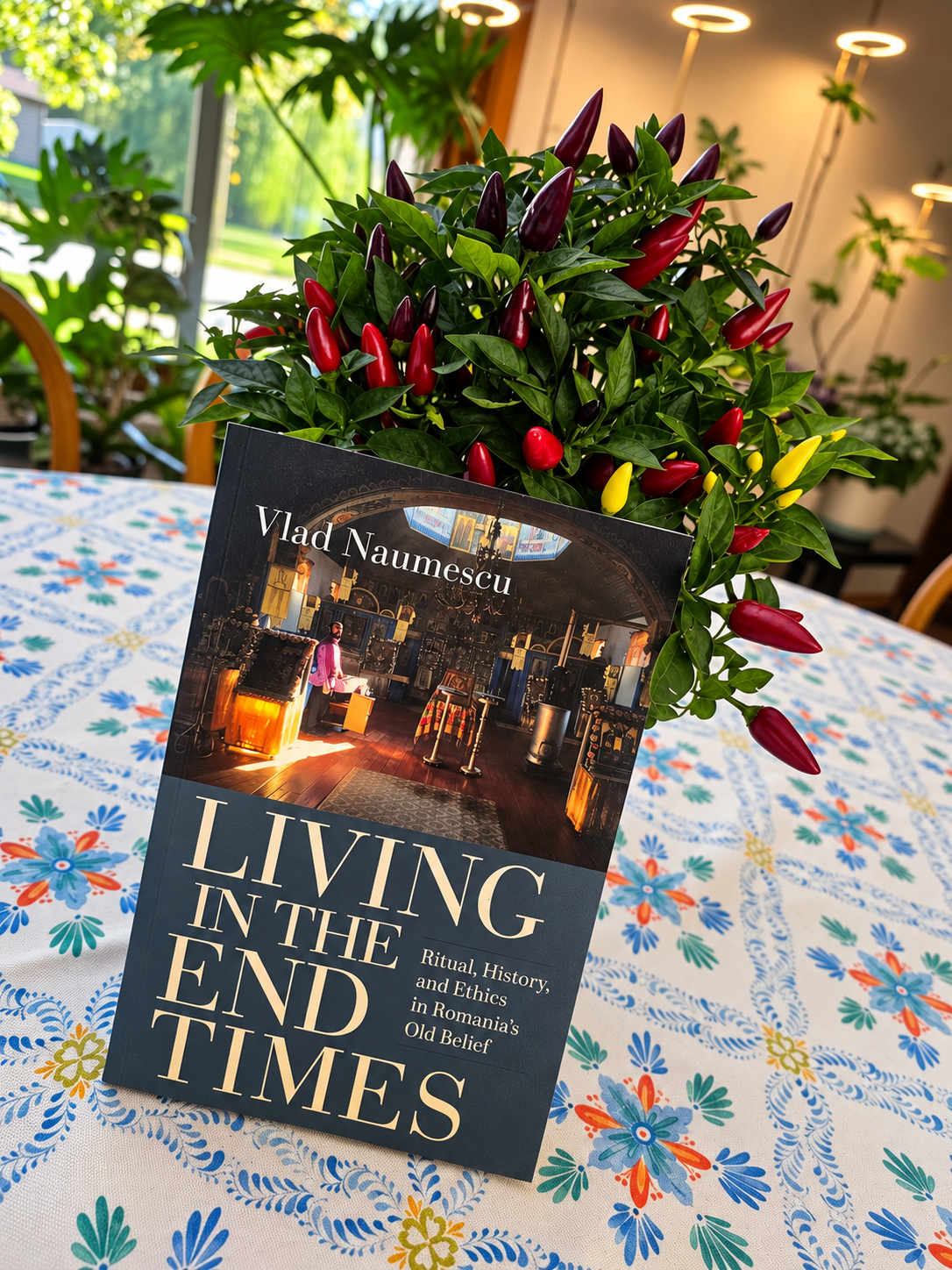
Review
When I first picked up Living in the End Times by Vlad Naumescu, I thought I had a fairly good idea of what I was getting into. The book focuses on ritual, history, and ethics among Romania's Old Believers, and I expected much of it to center on their religious practices. That is not exactly what I got, though, and perhaps that is why I found the book so interesting.
The Old Believers are a branch of Orthodox Christianity whose religious identity is rooted in maintaining their inherited traditions and beliefs. One thing that immediately grabbed my attention was how seriously they took orthodoxy. They emphasize following religious texts and traditions as precisely as possible.
Yet, there are complications. Many people in these communities cannot actually read the religious texts in their original language. On top of that, the texts themselves are not necessarily uniform from one community to the next. Some communities possess certain books while others do not. Variations, gaps, and differences exist in what they have available. The tradition must be followed correctly, even though access to the very texts that define that correctness is limited.
What a contradiction...
There is, however, a small group of people who can read these texts, whom Naumescu refers to as "Readers," and who can lead certain church functions without actually being priests. But again, their existence brings us back to the question of access. This is a religion built heavily around sacred texts, yet many of its followers cannot read them personally. That gives the physical books an importance that goes well beyond the words printed on their pages. They become heirlooms: preserved, protected, and inherited.
On top of that, these texts are not widely published. Instead, they are more likely to be transcribed by hand. In some ways, the books themselves begin to function almost like religious icons. Their physical survival becomes part of the religion's survival.
That becomes even more important when you consider what is, and has been, happening in many of these communities. Elders are passing away while younger people are leaving for larger cities. Knowledge that once passed naturally between generations suddenly becomes less likely to be passed on. Nowhere is this more apparent than in the training of their priests.
Becoming a priest within these communities is not something that happens quickly. Priestly candidates must learn the language of their texts and spend years under the elders' tutelage. It is an apprenticeship in the truest sense. Rural depopulation has hindered that apprenticeship process immensely.
The elders can no longer simply choose their apprentices from eager young candidates. In some places, they have to actively search for someone willing to learn the ways. And sometimes that means looking outside the community. This creates a certain fragility within both the priesthood and the religion itself. If the elders pass away before a new priest is properly trained, an entire community may find itself without a priest and face the potential loss of its religious traditions.
One moment in the book that stayed with me involved a child named Dani who enjoys pretending to be a priest. The community gently encourages it, with one villager even making him a priestly garment, because they hope that one day the game will become reality. Something about that is sweet yet unsettling. A child's make-believe might save the community's future.
The importance of religious objects does not end with books, though. Icons portraying saints also hold an important place in Old Believer households. They provide a way for religion to be present in the home, especially for those who cannot read the sacred texts themselves. Families carefully protect and pass these icons down. They can also become tied to particular stages of one's life, including birth and marriage, and may be altered or rearranged as those lives change.
Naumescu does a fantastic job of bringing attention to the actual people living within these communities. He did not simply arrive, collect his research, and leave. He spent time in these communities. He came to know the people and their histories. People welcomed him into their homes, and in some cases, he seems to have become closer to a friend or extended family member than an outside researcher.
I also found the relationship between religion and politics unexpectedly interesting. The Old Believers have lived through dramatically different political systems, including the Soviet Union and the modern political systems of Russia and Romania. Rather than simply enduring those changes, they learned how to work within whatever systems existed at the time. They adapted to political structures to protect their communities and secure recognition. Their beliefs did not necessarily modernize, but their methods of supporting those beliefs did.
As the title suggests, Old Believer thought also has an apocalyptic element. It is not all doom and gloom, but rather an understanding that the end of the world exists like a horizon. It could come tomorrow, or much later, but it IS coming. This uncertainty encourages Old Believers to live virtuously and behave rightly now, since they might not have the chance to correct their ways tomorrow.
I also came away with the feeling that they do not necessarily force this apocalyptic view on non-Old Believers, but I could be wrong. There does not seem to be much of the "The end is near, so YOU must repent!" attitude that we sometimes associate with apocalyptic religious movements.
Naumescu also provides extensive notes and resources at the end of the chapters, which I appreciate. They explain where his arguments come from and give readers a roadmap for digging deeper.
I do need to give one warning about the book. It is an ethnography. It is scholarly, dense, and written for an audience comfortable with anthropological language. I wouldn't necessarily recommend Living in the End Times to someone looking for a casual introduction to Old Believer Christianity. If the subject interests you, though, it is worth the effort.
And perhaps that is what I appreciated most about this book. It is not simply about a religious community trying to preserve the past. It is about people trying to ensure that their traditions have a future, even while believing that the world itself may not.
I give Living in the End Times by Vlad Naumescu 4.5 out of 5 stars.
This page contains an affiliate link. If you make a qualifying purchase through it, I may earn a small commission at no additional cost to you.
Conversation beneath the branches
Comments
No approved comments yet. You may be the first to join the conversation.